
Specialized Section
Why Did the Hard Drive Market Crisis Occur? An Analysis of Its Causes and Root Factors
19.10.2026, 11:11
Customers who planned to upgrade their server infrastructure or storage systems in 2026 are facing a price shock that is fundamentally changing the economics of IT investments. This is not a minor market correction, but a dramatic shift in the rules that have governed the market until now. Memory component prices have increased by 300–500% compared with the average price levels of 2025, while hard drive prices have risen by 200–300%. Such dramatic increases are forcing companies to reassess investment plans, postpone modernization projects, and look for new ways to secure the required performance and capacity at economically viable costs. What is driving this unprecedented development, and when can we expect a turnaround?
The current situation is not the result of a single event or a simple shortage of raw materials. It is the result of rapidly growing demand for AI infrastructure, slowly expanding manufacturing capacity, shifts in production priorities, and a market structure in which a small number of manufacturers control most of the supply.
The Changing Economics of AI – From Training to Large-Scale Inference
During the initial generative AI boom, attention focused primarily on GPU computing power and HBM memory. In 2026, however, a second phase is becoming increasingly important: running AI services at scale, known as inference. This is changing the requirements for data infrastructure.
What has changed technically:
- Phase A: Model training: Large GPU clusters, high data throughput, checkpoints, extensive training datasets, and high-speed parallel storage.
- Phase B: AI operations: Long-term retention of documents and multimodal data, vector databases, retrieval-augmented generation (RAG), caches, logs, and continuous data access.
During training, a significant portion of the data can be read repeatedly in large sequential operations. Inference introduces additional access patterns: large numbers of small requests, concurrent access by many users, frequent metadata reads, and long-term content retention.
This increases demand across different storage tiers:
- HBM and DRAM for computing and active working data.
- Enterprise NVMe SSDs for fast access, databases, indexes, and caches.
- High-capacity HDDs for cost-effective storage of large volumes of data.
- Object storage for datasets, documents, multimedia, and backups.
In September 2026, TrendForce estimated that demand for enterprise SSD capacity would grow by more than 80% year over year in 2026. AI is therefore not just creating demand for new servers. It is creating sustained demand for memory and storage that continues even after the computing infrastructure has been installed.

Wouldn't It Be Enough to Build New Factories and Produce More Memory and Hard Drives?
It’s not that simple. The memory industry has historically been cyclical, which is why manufacturers approach investments with considerable caution. When supply exceeds demand, prices fall sharply and manufacturers cut back on investment. When demand subsequently recovers, production capacity cannot be restored overnight.
In January 2026, Micron began construction of a new NAND manufacturing facility in Singapore as part of an investment of approximately USD 24 billion spread over ten years. However, initial production is not expected until the second half of 2028, meaning this investment will have virtually no impact on market conditions in 2026–2028.
Micron's history shows just how brutally cyclical the memory chip market can be. The company has repeatedly experienced periods of billion-dollar losses when supply exceeded demand and memory prices collapsed. In 2008 and 2009, its cumulative net losses exceeded USD 3.4 billion. Another loss of more than USD 1 billion followed in 2012, and losses reached approximately USD 5.8 billion in 2023. The current price boom therefore cannot automatically be considered the new normal: the industry's history shows that exceptional pricing power can be followed by an equally sharp reversal.
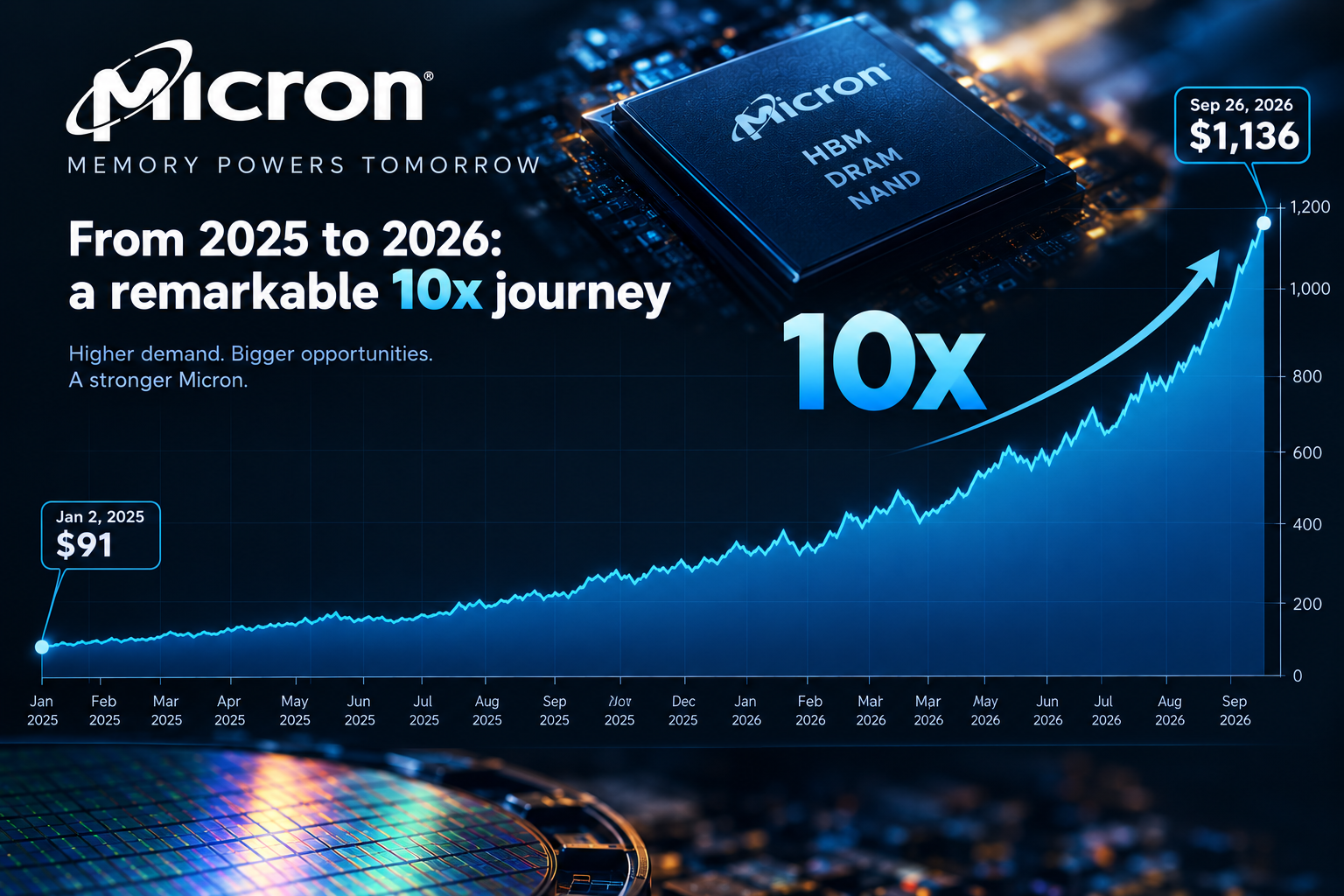
The exceptional nature of the current situation is also reflected in Micron's share price. Compared with the beginning of 2025, its share price had risen to more than ten times that level in the third quarter of 2026. This is great news for shareholders, but a warning sign for IT technology customers: the market still expects strong demand and limited memory chip supply to persist.
HDDs Face a Problem of Their Own: AI Is Exhausting the Capacity of the Three Remaining Manufacturers
The situation is different for hard disk drives. The issue here is not NAND, but the highly specialized manufacturing of magnetic disks, heads, mechanical components, and electronics.
The global HDD market is concentrated primarily among three manufacturers: Seagate, Western Digital, and Toshiba.
Moving to higher capacities is not simply a matter of installing more platters. Higher recording densities, new head and recording technologies, and tighter mechanical tolerances increase the complexity of both development and qualification.
What do the manufacturers' figures show?
- Seagate
In its fiscal year 2026 results, the company reported total HDD shipments of 789 exabytes for the year, compared with 595 EB in the previous fiscal year. It also announced that most of its nearline capacity is reserved under long-term agreements through calendar year 2028. - Western Digital
In February 2026, the company's management announced that almost its entire production for calendar year 2026 had already been sold. It also has long-term agreements with selected customers covering 2027 and 2028.
These figures are significant. This is not merely analysts predicting that HDDs might become unavailable. The manufacturers themselves describe a situation in which a large share of future production already has a committed buyer.
Like memory chip manufacturing, the disk industry is highly cyclical. Throughout their histories, Seagate and Western Digital (WD) have repeatedly faced severe pricing pressure, excess manufacturing capacity, and industry consolidation. Building new factories and expanding production are long-term, capital-intensive projects whose returns cannot easily be adjusted to fluctuations in demand. Manufacturers are therefore looking for ways to increase the volume of data they sell, rather than simply the number of drives they produce. The key metric is becoming the storage capacity delivered to the market, measured in exabytes.
The technological foundation of this shift is increasing magnetic recording density. In March 2026, Seagate announced drives with capacities of up to 44 TB using Heat-Assisted Magnetic Recording (HAMR), a technology that uses a laser to preheat the recording medium during magnetic writing. The laser briefly heats a tiny area of the platter, allowing a smaller magnetic bit to be written. Once the area cools, the recording remains stable. This makes it possible to overcome the physical limits of traditional magnetic recording. Seagate is working toward drives with capacities of up to 100 TB. This is not simply about increasing the number of platters: new magnetic materials, laser and nanophotonic technologies, more precise read/write heads, and more sophisticated recording control all play essential roles.
Long-Term Contracts Are Changing How the Market Works
Under normal conditions, a buyer can compare several distributors, choose the lowest-priced offer, and order components with a relatively short lead time.
In the current environment, however, availability is becoming just as important as price.
Long-term agreements (LTAs) can provide manufacturers with:
- predictable demand;
- the ability to plan investments based on confirmed orders;
- more stable business relationships with their largest customers.
- For buyers, they also provide greater certainty about the volumes they can secure.
To secure these benefits, major players such as data center operators and technology manufacturers (Hitachi Vantara, IBM, Dell, HP, etc.) are willing to accept higher prices or commit to purchasing over longer periods.
Conclusion: The End of the Rule That “Waiting Means Paying Less”
For almost two decades, IT customers have been accustomed to a simple principle: if they postpone a purchase, they will later be able to buy more performance and greater capacity for the same budget. This assumption is no longer holding true. Artificial intelligence has created a new, long-term source of demand for memory and storage, while expanding manufacturing capacity is slow and capital-intensive. Memory, enterprise SSD, and hard disk manufacturers are therefore increasingly planning production well in advance and securing significant portions of their capacity for major customers through long-term agreements, with much of their output already committed through 2028 at agreed prices.
After three quarters of volatile market conditions, during which prices increased by more than 50% in each quarter, the first signs of stabilization are now becoming visible. For example, TrendForce still expects contract prices for memory to rise in the fourth quarter of 2026: by 10–15% for DRAM and 15–20% for NAND Flash. However, this is a different situation from the increases of 50% or more seen previously.
Sharp quarter-on-quarter price increases should therefore moderate, but stabilization does not mean a return to 2025 prices. For 2027 and 2028 budgets, this means persistently high prices, with different trends across individual product categories rather than the prospect of across-the-board price reductions.
This change is also fundamentally transforming the work of corporate purchasing departments and IT procurement teams. Instead of automatically postponing purchases, they will need to forecast requirements more accurately, verify the availability of specific components, secure budgets in advance, and make purchasing decisions more quickly. The ability to respond flexibly, negotiate production capacity allocations, assess alternative configurations, and coordinate procurement with technical teams before every project detail has been finalized will become increasingly important.
Some signs of easing are already appearing in commercial terms as well: while offer validity was often limited to approximately ten days during the most volatile period, some suppliers are now extending it to two to four weeks. However, this alone does not mean that prices are returning to normal or that product availability is guaranteed.
The main lesson is different: in the new environment, waiting can mean not only paying a higher price but also losing an allocated production slot and facing a later delivery date. Companies that can make timely, flexible decisions based on current market information will therefore gain a competitive advantage.